
The nine Navagraha temples are not one site you drive to. They are nine separate temples spread across roughly 60 kilometres of the Kaveri delta, in three districts plus one union territory, and most of them close for three to four hours in the middle of the day. Add a five-to-six hour drive just to reach the region from Chennai, and route planning becomes the whole job.
Most pages selling a Navagraha temple tour package from Chennai give you a price and a list of nine names. Very few tell you how far apart the temples actually are, or what a quoted figure does and does not cover. This guide covers the nine temples and where they sit, a workable route, realistic 2-day and 3-day plans, an honest answer on doing it in one day, how vehicle costs are calculated, and what to confirm before accepting any quotation. (Note: this is the traditional circuit around Kumbakonam and Mayiladuthurai, not the nine Navagraha temples inside Chennai city.)
Table of Contents
How Many Days Do You Need for a Navagraha Temple Tour from Chennai?
Two days is the practical minimum. Three days is the comfortable answer for families travelling with elderly parents or young children.
Chennai to Kumbakonam is roughly 280–300 km, about six hours by road. Covering all nine temples in the region adds another 250–300 km. With the return leg, a realistic round trip is 900–1,000 km – and you lose roughly 12:30 PM to 4:00 PM each day to temple closures.
| Duration | What it realistically looks like | Best suited to |
|---|---|---|
| 1 day | Only feasible with a pre-dawn or overnight departure, and even then very rushed | Small groups of fit adults accepting a brief darshan |
| 2 days | The most common format. One night in Kumbakonam or Mayiladuthurai, early starts both days | Working adults, groups without mobility concerns |
| 3 days | Two nights, no pre-dawn starts, proper meal breaks, time for poojas | Senior citizens, families with children, first-time pilgrims |
Treat all drive times as indicative – highway conditions, weather, festival traffic and time spent at each temple will move them.
What Are the 9 Navagraha Temples?
| Temple | Location | Graha (planet) | Note |
|---|---|---|---|
| Suriyanar Kovil | Near Aduthurai, Thanjavur district (~15 km west of Kumbakonam) | Surya (Sun) | Surya is the presiding deity here, with separate shrines for all nine grahas |
| Thingalur (Kailasanathar) | Thanjavur district, Kumbakonam–Thiruvaiyaru road (~33 km) | Chandra (Moon) | Shiva as Kailasanathar presides; Chandra in a separate shrine |
| Vaitheeswaran Koil | Mayiladuthurai district, ~5 km from Sirkazhi | Angaraka / Chevvai (Mars) | Presiding deity Vaidyanathaswamy with Thaiyalnayagi; traditionally associated with healing |
| Thiruvenkadu (Swetharanyeswarar) | Mayiladuthurai district, ~8 km from Poompuhar | Budha (Mercury) | Budha enshrined within the Swetharanyeswarar temple |
| Alangudi (Apatsahayesvarar) | Thiruvarur district, ~16–18 km south of Kumbakonam | Guru (Jupiter) | Guru is worshipped here in the form of Dakshinamurthy |
| Kanjanur (Agneeswarar) | Thanjavur district, ~3 km from Suriyanar Kovil | Shukra (Venus) | Traditionally, Shukra is worshipped as Sri Haradatta Sivachariyar |
| Thirunallar (Dharbaranyeswarar) | Karaikal district, Puducherry UT, ~5 km from Karaikal | Shani (Saturn) | The best-known Shani sthalam, with the Nala Theertham tank |
| Thirunageswaram (Naganathaswamy) | Thanjavur district, ~6 km east of Kumbakonam | Rahu | Known for the Rahu abhishekam, during which the milk offered is traditionally said to change colour |
| Keezhaperumpallam (Naganathaswamy) | Mayiladuthurai district, ~3 km from Poompuhar | Ketu | Completes the circuit as the Ketu sthalam |
Note that Thirunallar is not in Tamil Nadu – it sits in the Karaikal district of the Union Territory of Puducherry. That has a practical consequence: a Tamil Nadu commercial vehicle usually needs a Puducherry permit to enter, and the cost is normally passed on to you. Ask about it before you pay an advance.
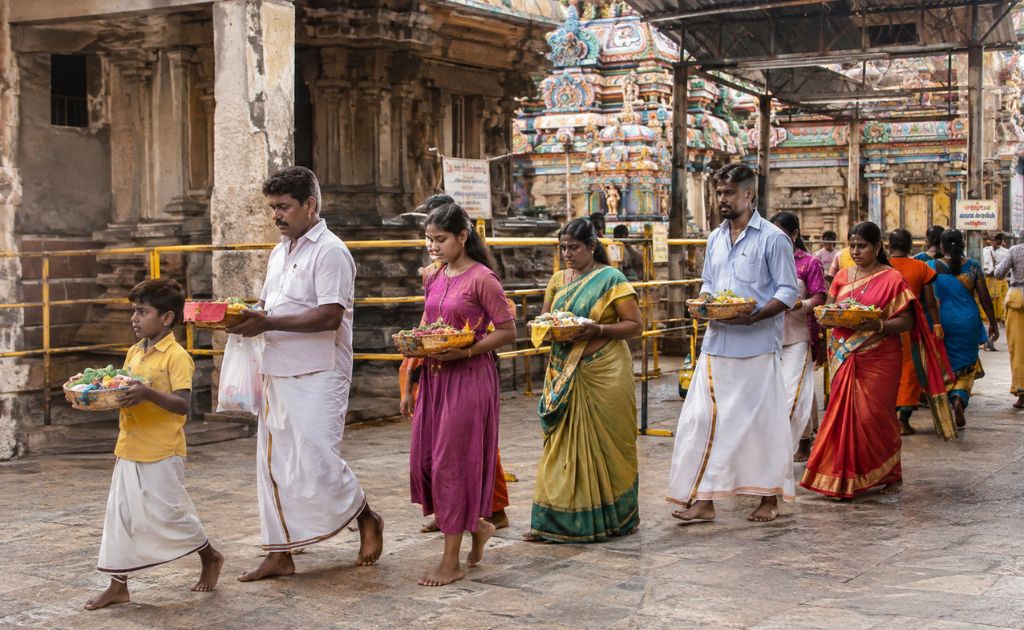
Best Navagraha Temple Route from Chennai
There is no single correct sequence, and operators genuinely differ. Some follow the traditional astrological order; most optimise for driving. What actually decides your day is geography plus opening hours.
Once you see the geography, the route plans itself:
- Suriyanar Kovil and Kanjanur are about 3 km apart – always one stop.
- Vaitheeswaran Koil, Thiruvenkadu and Keezhaperumpallam sit within roughly 20 km of each other near Sirkazhi and Poompuhar – always one cluster.
- Thirunageswaram and Alangudi both hug Kumbakonam, 6 km east and 16–18 km south, but on opposite sides of town.
- Thingalur is the western outlier, ~33 km from Kumbakonam toward Thiruvaiyaru.
- Thirunallar is the eastern outlier, ~55–60 km from Kumbakonam and ~33 km from Mayiladuthurai.
Getting there from Chennai: the standard route to Kumbakonam runs on NH 32 to Vikravandi, then NH 36 through Panruti and Sethiathope. To start with the Sirkazhi cluster instead, stay on NH 32 through Puducherry, Cuddalore and Chidambaram – Vaitheeswaran Koil is around 230–260 km from Chennai, roughly five hours, which is why several itineraries begin there.
Which end you start from is the real decision. Starting at Sirkazhi clears three temples on day one before dark, then moves inland; starting at Kumbakonam means a longer first drive but a tighter base afterwards. Both work. What does not work is zig-zagging between the two clusters more than once. Choose your base before your order – Kumbakonam is central to six of the nine temples, while Mayiladuthurai sits closer to the coastal cluster and Thirunallar.
2-Day Navagraha Temple Itinerary from Chennai
Approximate windows, not guarantees.
Day 1 – Chennai to the coastal cluster, then Kumbakonam
- Leave Chennai 4:00–5:00 AM. Breakfast en route on NH 32, around Tindivanam or Cuddalore.
- Mid-morning at Sirkazhi: Vaitheeswaran Koil (Angaraka), Thiruvenkadu (Budha), Keezhaperumpallam (Ketu) – all within about 20 km.
- Lunch around Sirkazhi or Mayiladuthurai. This absorbs the midday closure.
- Afternoon: Thirunallar (Shani) in Karaikal, after the temple reopens.
- Evening: drive to Kumbakonam, check in, overnight.
Day 2 – the Kumbakonam cluster, then Chennai
- Early start: Thirunageswaram (Rahu), ~6 km east.
- Suriyanar Kovil (Surya) and Kanjanur (Shukra), 3 km apart, to the west.
- Thingalur (Chandra), the western outlier.
- Back towards Kumbakonam for Alangudi (Guru), to the south.
- Lunch, then depart for Chennai. Expect a late evening arrival.
Two days works, but leaves very little slack. One long queue at Thirunallar on a Saturday and the plan tightens considerably.
3-Day Navagraha Temple Itinerary from Chennai
The three-day version does not add temples. It removes pressure – which for most families is the point.
- Day 1: Depart Chennai 6:00–7:00 AM with a proper breakfast stop. Reach Sirkazhi by early afternoon and cover Vaitheeswaran Koil, Thiruvenkadu and Keezhaperumpallam across the afternoon and evening session. Overnight Mayiladuthurai or Kumbakonam.
- Day 2: Thirunallar (Shani) in the morning session, with time for the Nala Theertham and an unhurried darshan. Thirunageswaram (Rahu) in the afternoon. Overnight Kumbakonam.
- Day 3: Suriyanar Kovil and Kanjanur in the morning, then Thingalur, then Alangudi around lunch. Depart for Chennai in the afternoon.
The gain: no pre-dawn wake-ups, room for archanai or abhishekam without watching the clock, a real lunch break each day, and enough slack that a festival crowd does not wreck the plan. Travelling with parents in their seventies? Book this version.
Should You Do the Navagraha Tour in One Day from Chennai?
Honestly: it is possible, and for most groups it is a poor idea.
One day means roughly 900–1,000 km in 24 hours, a midnight or 2:00 AM departure, and nine stops split around a closure of about 12:30 to 4:00 PM. That leaves ten to fifteen minutes per temple – less than the time to park, walk to the sanctum, queue and return. It also puts a single driver on the road for a very long stretch. If an operator offers an overnight departure, ask how many hours the driver will be at the wheel and what the rest plan is.
One day can work if your group is small and fit, you accept a brief darshan, and you avoid Saturdays, amavasai and festival days. Choose two or three days if anyone is elderly or has mobility limitations, you want to perform poojas, or children are travelling.
Navagraha Temple Tour Cost from Chennai: What Drives the Price
A vehicle rental tariff is what a travel company charges to supply a vehicle with a driver. A complete pilgrimage package price additionally bundles accommodation, sometimes meals, sometimes darshan or pooja assistance. Comparing one against the other will mislead you every time.
What determines a vehicle quotation: vehicle type and seating capacity; passenger count and luggage volume; number of days; total kilometres run and any minimum-km-per-day policy; Chennai pickup and drop points; driver bata, usually per calendar day; tolls, parking and the Puducherry permit for Thirunallar; extra hours and extra kilometres; and any add-on sightseeing such as Thanjavur, Darasuram or Swamimalai.
What it normally excludes: hotel rooms, meals, archanai and abhishekam tickets, and special pooja arrangements.
A worked example. VPL publishes a Tempo Traveller per-km rate list. At the time of writing, a 12-seater Tempo Traveller is listed at ₹23 per km with a minimum of 250 km per day and driver bata of ₹700 per calendar day. On a three-day Navagraha trip of roughly 950 km, actual kilometres exceed the 750 km minimum, so billing follows actual running: about ₹21,850 for distance plus ₹2,100 bata – around ₹24,000 for vehicle and driver, before tolls, parking and the Puducherry permit, and excluding hotels, food and poojas.
That is an illustration of the arithmetic, not a quotation – rates change and your kilometres will differ, so confirm current rates when you enquire. But knowing the arithmetic lets you sanity-check any quotation from anyone. If a per-km rate multiplied by realistic kilometres lands nowhere near the total you have been given, ask what the difference covers.
Car vs Tempo Traveller vs Mini Bus
| Vehicle | Suitable group | Comfort on a 900+ km trip | Best for |
|---|---|---|---|
| Sedan (Etios / Dzire) | Up to 4 | Adequate; limited boot space | Couples, small families |
| Innova / Innova Crysta | 6–7 | Good; higher seating suits older passengers | Families of five or six |
| Tempo Traveller 12+1 | Up to 12 | Pushback seats, 600 L boot with roof carrier | Extended families |
| Tempo Traveller 16+1 / 18+1 | 16–18 | Pushback seats; the 18-seater boot is smaller at 300 L | Larger family groups |
| Mini bus 21+1 / 25+1 | 21–25 | Pushback seats; the 25-seater carries 1,000 L of luggage | Temple committees, association groups |
Car works when the group genuinely fits – do not squeeze six adults into an Innova for 900 km to save money. Tempo Traveller is the sensible middle for most Navagraha groups: everyone travels together, luggage goes in the boot rather than on laps, and pushback seats matter on the long Chennai legs. VPL’s Tempo Traveller rental range in Chennai covers 12, 16 and 18-seater options. Mini bus makes sense above about eighteen travellers – VPL’s 25-seater mini bus page publishes a separate temple-tour rate.
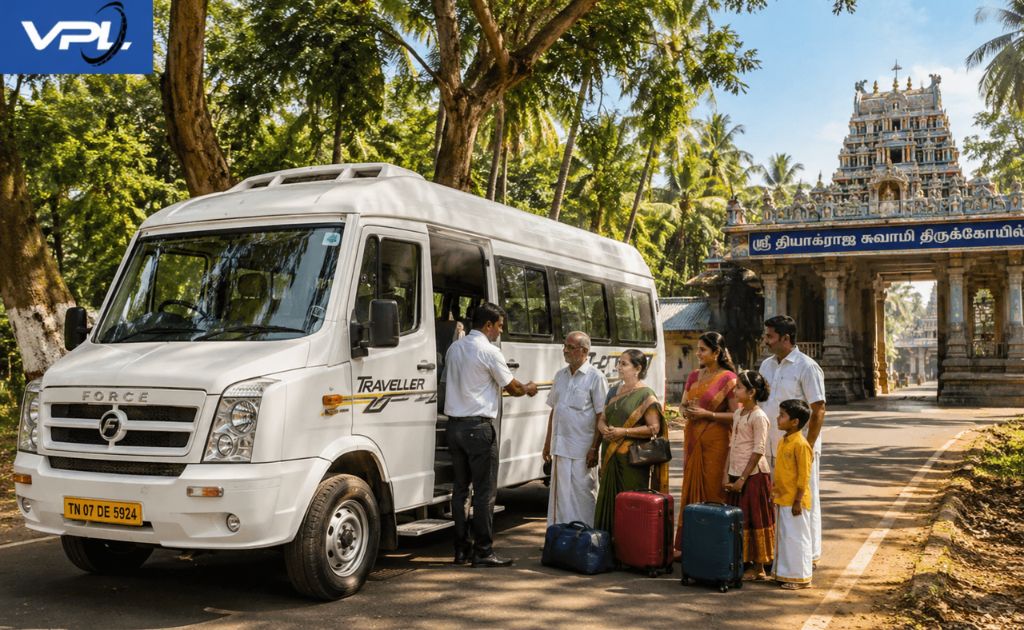
Which Tempo Traveller Size Is Best?
Bigger is not automatically better – an oversized vehicle costs more per kilometre and is harder to park in narrow temple streets.
- 12-seater – 12+1 and 14+1 seating, pushback seats, 600 L boot plus roof carrier. Usually the right call for eight to ten travellers with overnight bags.
- 16-seater – 16+1, pushback seats, 450 L boot. Comfortable for twelve to fourteen.
- 18-seater – 18+1, pushback seats, but only 300 L of boot space. Note that carefully: more seats does not mean more luggage room.
Count actual travellers, add a seat of slack if anyone is elderly or large-framed, then check luggage volume separately.
Navagraha Temple Tour for Senior Citizens
Most Navagraha trips from Chennai are booked by adult children for their parents. A few things make a real difference:
- Take three days, not two. The single most effective change available.
- Refuse the 2:00 AM departure. A 6:00 AM start with a proper breakfast stop beats arriving at the first temple already exhausted.
- Check boarding, not just seats. A Tempo Traveller’s footboard height matters more than its seat count – ask when you enquire.
- Plan rest stops roughly every two hours on the Chennai legs, with clean restroom access.
- Carry prescribed medicines in hand luggage, not the boot, with a written list.
- Keep water accessible. The delta is hot and humid outside winter, and temple queues involve standing.
- Accept that you may skip a temple. If a queue is two hours long and your mother is tired, moving on is a reasonable decision.
- Tell your travel provider about mobility needs before booking, not on the morning of departure – vehicle choice, seating and pace can all be adjusted in advance.
This is general travel guidance, not medical advice. If anyone in your group has a heart condition, mobility limitation or any condition affected by long travel, please consult their doctor before planning the trip.
Temple Timings and Darshan Planning
Most South Indian temples follow a two-session pattern: roughly 6:00 AM to 12:00 or 12:30 PM, closed through the afternoon, reopening around 4:00 PM until 8:30 or 9:00 PM, with poojas at fixed kala timings. Thirunallar’s Sri Dharbaranyeswara Swamy temple, for example, publishes hours of 6:00 AM to 9:00 PM with a gap between the midday Utchi Kalam and the evening Sayaratchai.
Timings change by temple, by season and on festival days, and these temples sit under different administrations – Thirunallar under the Puducherry government, Vaitheeswaran Koil under the Dharmapuram Adheenam, most of the rest under Tamil Nadu HR&CE. Check current timings on the HR&CE temple portal or by calling the temple. Do not rely on timings published on any travel website, including this one.
Two crowd notes: Thirunallar draws very large crowds on Saturdays and during Sani Peyarchi transits, and Alangudi is busy during Guru Peyarchi.
Temple Dress Code and Etiquette
- Dress modestly – dhoti or veshti for men, saree or salwar for women. Many South Indian temples require men to remove their shirt inside the inner prakaram.
- Footwear is left outside. Carry a small cloth bag, and expect hot stone underfoot in summer.
- Photography is restricted or prohibited inside many sanctums – look for signage and ask if unsure.
- Archanai and abhishekam tickets are bought at a counter inside the temple. Carry cash; UPI is not accepted everywhere.
Best Time to Plan the Navagraha Tour
October to March is generally the pleasant season here, and Tamil Nadu Tourism suggests December to February as ideal for the Thanjavur area. Summer temperatures in the delta reach 35–40°C, punishing on a circuit involving barefoot walking.
One caveat: the Northeast Monsoon runs October to December, and this is the wettest part of Tamil Nadu – Mayiladuthurai’s October–December rainfall normal is close to 890 mm, and the coastal cluster sits right in it. The practical sweet spot is late December to February. Travelling April to June? Plan the earliest possible starts and carry more water than you think you need.
Where to Stay
Kumbakonam is the default base: central to six of the nine temples, with the widest range of budget and mid-range hotels and plenty of pure-vegetarian restaurants. Mayiladuthurai works better if your route weights the coastal cluster and Thirunallar. Thanjavur only if you are adding the Brihadeeswarar temple.
On a three-day itinerary, one night in Mayiladuthurai followed by one night in Kumbakonam removes almost all backtracking. Book ahead during festival periods and the December–January season. We do not recommend specific hotels here – check current reviews and confirm directly.
What to Carry
- Government photo ID for every traveller, plus vehicle and hotel booking confirmations
- Comfortable footwear you can slip off repeatedly
- Traditional or modest clothing for temple entry
- Prescribed medicines in hand luggage, with a written list
- Water bottles, refilled at every stop
- Cash for archanai, abhishekam and offerings, with UPI as backup
- A small bag for footwear and valuables
- Sun protection – cap, sunglasses, sunscreen
- An umbrella between October and December
- Phone charger and power bank
- A written list of the nine temples in your planned order
Common Mistakes When Planning a Navagraha Tour from Chennai
- Forcing all nine temples into one day without accounting for the midday closure.
- Ignoring temple timings and arriving at 1:00 PM to a closed sanctum.
- Booking a vehicle one size too small and travelling 900 km uncomfortably to save a few thousand rupees.
- Checking seat count but never boot space.
- Not adjusting the pace for elderly travellers, then abandoning temples on day two.
- Assuming a per-km rental tariff equals the total trip cost. Tolls, parking, permits, hotels and food sit outside it.
- Not asking about the Puducherry permit for Thirunallar until the driver raises it at the border.
- Travelling on a Saturday or during Sani Peyarchi without allowing for the crowds at Thirunallar.
- Not confirming inclusions and exclusions in writing before paying an advance.
- Booking during peak Northeast Monsoon with no weather contingency.
Why Consider VPL Travels for Your Navagraha Trip
Straightforwardly: VPL Travels does not currently publish a fixed-price Navagraha temple tour package. What VPL provides is the vehicle, the driver and the outstation arrangements – which for a circuit like this is often what you actually need, because no two families plan an identical itinerary.
What is verifiable:
- VPL Travels has operated from Chennai since 2002, providing vehicle rental services.
- The fleet spans sedans, Innova and Innova Crysta, Tempo Travellers at 12+1, 16+1 and 18+1, and mini buses at 21+1 and 25+1 – covering everything from a couple to a full temple group.
- Outstation per-kilometre rates, the minimum-km policy and driver bata are published openly, so you can check the arithmetic on your own quotation.
- Tolls, parking and interstate permits are explicitly stated as charged separately – relevant here, since Thirunallar sits in Puducherry UT.
- VPL already runs this corridor, with existing Chennai to Kumbakonam and Chennai to Chidambaram route services alongside pilgrimage transport to Tirupati, Rameswaram, Velankanni and Kanyakumari.
What we will not claim: VPL does not advertise itself as a Navagraha specialist and has no published Navagraha itinerary. If you want a fixed all-inclusive package with hotels and pooja tickets bundled, say so when you enquire and we will tell you what can and cannot be arranged.
How to Request a Customised Quotation
Because there is no fixed package, share these details and you will get a realistic figure rather than a placeholder:
- Travel dates, and whether they are flexible
- Number of passengers, including children, plus rough luggage volume
- Pickup location in Chennai, and drop if different
- Preferred duration – 2 days or 3 days
- Preferred vehicle, or ask for a recommendation based on group size
- Your rough itinerary – starting cluster, base town, any add-ons
- Senior citizen or mobility requirements, if any
- Whether you want hotel suggestions, or will arrange your own stay
Then ask for these in writing: total kilometres assumed, the per-km rate beyond that, driver bata per day, whether tolls, parking and the Puducherry permit are included or extra, and the advance payment and cancellation terms.
- phone +91 9444188844 or +91 7845882178,
WhatsApp on the same number. Send the eight points above in one message and you will get a properly costed reply rather than a back-and-forth.
Frequently Asked Questions
How many days are needed for a Navagraha temple tour from Chennai?
Two days is the practical minimum, three days is comfortable. The round trip covers roughly 900–1,000 km, and most temples close from about 12:30 PM to 4:00 PM.
Can all nine Navagraha temples be covered in 2 days?
Yes, and it is the most commonly booked format. It needs early starts both days, one overnight in Kumbakonam or Mayiladuthurai, and leaves little slack for long queues.
What is the best route for the Navagraha temples from Chennai?
There is no single correct order. Practical routes group Vaitheeswaran Koil, Thiruvenkadu and Keezhaperumpallam together, pair Suriyanar Kovil with Kanjanur, and treat Thingalur and Thirunallar as outliers on opposite sides of Kumbakonam.
How much does a Navagraha temple tour from Chennai cost?
It depends on vehicle type, group size, days, total kilometres, driver bata, tolls, parking and the Puducherry permit. A vehicle-and-driver quotation is a different thing from an all-inclusive package price.
Which vehicle is best for a Navagraha temple tour?
Up to four passengers, a sedan. Five to seven, an Innova or Crysta. Eight to eighteen, a Tempo Traveller. Above eighteen, a mini bus. Check luggage capacity separately from seat count.
Is a Tempo Traveller suitable for senior citizens?
It can be – pushback seats and space to move help on long drives. Ask about footboard height and boarding assistance, and mention mobility requirements before booking.
Is Thirunallar in Tamil Nadu?
No. Thirunallar is in the Karaikal district of the Union Territory of Puducherry, about 5 km from Karaikal town. A Tamil Nadu commercial vehicle may need a Puducherry permit, so confirm whether that cost is included.
When is the best time to do the Navagraha tour?
Late December to February is generally the most comfortable window. October to December brings heavy rain to the delta, and April to June regularly reaches 35–40°C.
Are temple pooja and darshan charges included?
No. Archanai, abhishekam and special pooja tickets are paid directly at the temple and sit outside a vehicle rental quotation. Carry cash.
Does vehicle rental include a driver?
Yes – VPL’s vehicle rentals come with a driver. Driver bata is charged on a calendar-day basis, so a trip spanning two dates attracts two days of bata
